
Where does spiritual truth come from? How does it travel from the divine to us humans? What are the most common sources of spiritual truth used by religious people?
Good questions. I don’t know the answers. But it’s a fun thought exercise, so I’ll pretend I know what I’m talking about!
The Sources
In my experience, there are three primary sources:
- Scripture (the Bible, the Koran, the Tanakh, the Dhammapada, the Book of Mormon, etc)
- Authority Figures (the Pope, the Prophet, the Pastor, the Rabi, the Imam, the Monk, etc)
- Yourself (your experiences, your thoughts, your feelings, etc)
Scripture examples:
- “The Bible says God will answer your prayer.”
- “The Koran says eating pork is wrong.”
- “The Book of Mormon says Jesus Christ appeared and ministered to the Nephites after his death and resurrection.”
Authority Figure examples:
- “The Pope says the Eucharist and communion wine is literally transformed into the body and blood of Christ when consumed through a process called transubstantiation,”
- “The Dalai Lama says compassion is the root of happiness.”
- “Joseph Smith says drinking coffee is a sin.”
Yourself examples:
- “I asked God in prayer to know which church to join and He led me to this one.”
- “I have learned that doing 30 minutes of mindfulness meditation each day is good for me.”
- “I had a vivid dream that showed me I was going to give birth to a daughter.”
My attempt at grouping religions based on their preferences for sources of truth
Yes, I am shooting from the hip here. No, I am not an epistemology expert. Yes, I do have some experience with each of these religions (see my logbook). No, this is not an exhaustive list.
Here’s my Venn diagrams that roughly show how much importance is placed on each source of truth from various religions.
Legend:
🔵 = Scripture.
🔴 = Authority Figures.
🟢 = Yourself.
🟡 (slightly transparent) = The preferences of the stereotypical member of the religious group listed below.
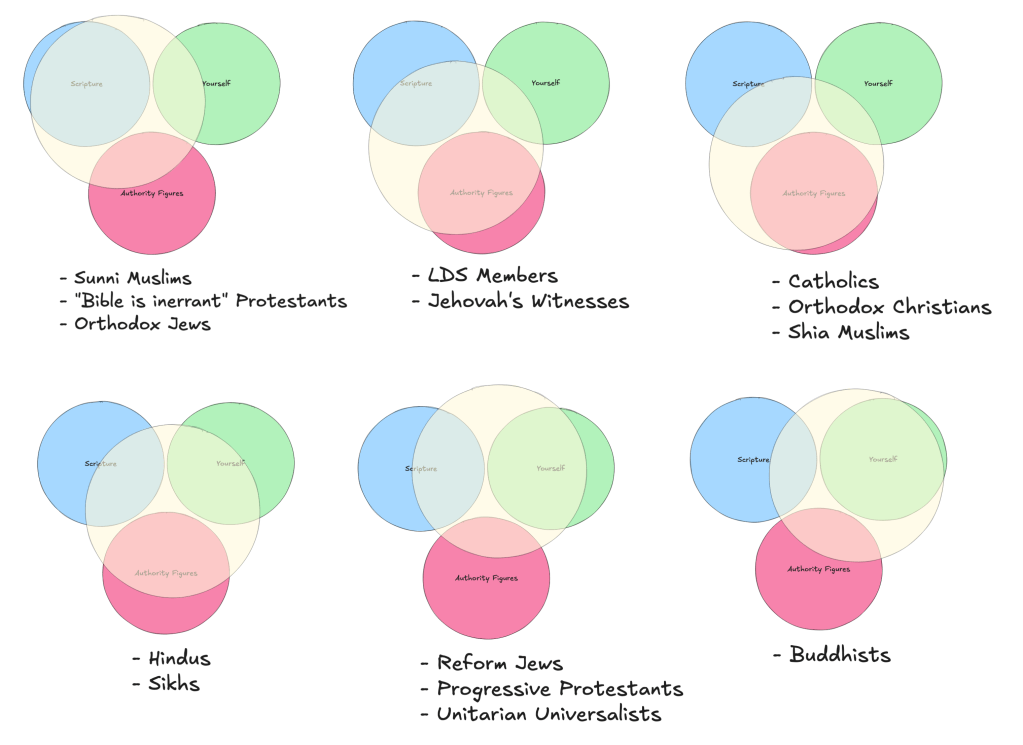
I like this diagram because it’s interesting to compare and contrast different religious groups with this little framework.
It’s not perfect. Most of these religions can (should?) be further divided into subgroups. Within all religious groups exists nuance –each member has their own views and beliefs that may or may not align with the stereotype.
My Own Venn Diagram
For many reasons, the past few years have changed me a lot. Earlier in my life I trusted scripture and authority figures more than myself. If they said something was true, it was true –no further questions or dialog needed.
Nowadays, however, I realize the nuance in all things. There is an exception to every rule. There are questions that don’t have easy answers. There is a shadow side to all organizations (even churches). There is imperfection and bias in everything people touch.
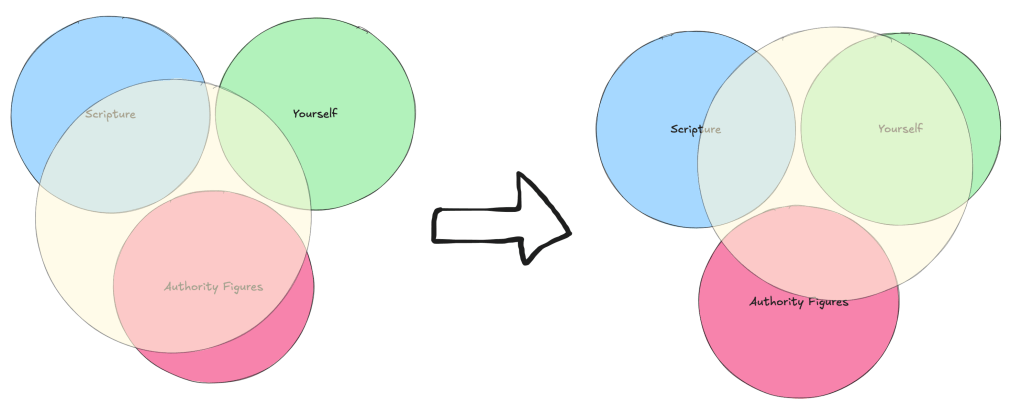
I still have faith that God works through scripture and authority figures to lead and guide us, but I believe a direct connection with deity is the most important. God wants a personal relationship with you and me.
Conclusion
These Venn diagrams were fun to create. I enjoy seeing the similarities and differences between religions and my own views.
So, how did I do? Do you agree with the generalizations I made about the sources of truth preferences for each religion? Where does your personal transparent yellow circle sit in this diagram? Feel free to share your thoughts with me. 🙂
Whether it’s from the writings of an ancient text, spoken by a charismatic leader, or confirmed to you through personal experience, your spiritual truths belong to you and no one else. Own it. Grow it.
 Kev's Blog