
- Why?
- Caveats
- The Issues
- #1 Racism
- #2 Systemic Sexism
- #3 LGBTQ Discrimination
- Why Does God Allow These Injustices to Happen?
- Conclusion
Why?
As an active, life-long member of the Church of Jesus Christ of Latter-day Saints I care deeply about the church organization, its leaders, and its members all across the world.
I believe in God, Jesus Christ, and His Gospel. I believe we are all children of God –with a divine heritage and God-like potential. He made each of us wonderfully unique and wants us to love one another despite and even because of our differences. Jesus showed us the way through his perfect example of unconditional love, and he wants us to follow him.

I believe God gives each of us revelation and wants to guide and direct us in our lives. He has also given us agency. God allows His children to not listen, to choose their own path, to fail, to fall down, to hurt others, to learn, and to grow. This applies to every one of us.
God is perfect, we are not.
This blog post is my attempt at recognizing where we, as beautiful yet imperfect people, have strayed. Writing this was a painful process for me. I had to confront uncomfortable facts and truths that I don’t like to admit are part of our history. It’s my hope that you will read this with an open heart and an open mind –seeking to learn and grow.
Caveats
- I am not a church historian, scholar, or apologist. Please feel free to dig deeper, look at sources, and let me know if you believe I’m getting something wrong here.
- I believe the social issues in the church negatively affect everyone, but disproportionately people who are not like me, namely: Black people, women, and those who identify as LGBTQ individuals.
The Issues
- Racism
- Systemic Sexism
- LGBTQ Discrimination
#1 Racism
Racism In The Early Church
Both outside the church and inside the church, history is messy.
- In 1852, Brigham Young and the first presidency put a restriction on all Black people of African descent prohibiting them from receiving the priesthood or doing ordinances in the temple. This ban was put in place despite the fact that early Black church members had already been ordained to offices in the Priesthood (for example: Elijah Able, Walker Lewis, Peter Kerr, etc).
- In 1894, Jane Manning James was sealed as a servant (AKA “slave”) to Joseph Smith’s family. The sealing was done via proxy, of course, because she wasn’t allowed in the temple (source).
- In 1949, the first presidency wrote that Black people were “not entitled to the full blessings of the gospel,” and referenced previous revelations on the preexistence as justification. In essence, they were suggesting that Black people were the one-third group in the pre-mortal world who were “fence sitters” when choosing between God or the devil (source).
Early members and leaders of the church often equated whiteness with righteousness, and taught that originally God made his children white in his own image. Joseph Smith described him as having a “white complexion” and “blue eyes” (source). Several Black members were told that they would become “white” through their righteousness. For example, Hyrum Smith told Jane Manning James in a patriarchal blessing that she would become “white and delightsome.” Elijah Able and Darius Gray were told similar things (source).
Additionally, some members believed that being Black was a curse from God. This idea predates Joseph Smith and the restoration by hundreds of years and is most commonly known as the “curse of Ham”. Christian slaveholders used this idea of a curse as a main justification for enslaving Black people (source).
The idea of a curse is still perpetuated in church culture today. The Book of Mormon has a few mentions of a curse from God, which curse can be interpreted as meaning “a skin of blackness.”
21 And he had caused the cursing to come upon them, yea, even a sore cursing, because of their iniquity. For behold, they had hardened their hearts against him, that they had become like unto a flint; wherefore, as they were white, and exceedingly fair and delightsome, that they might not be enticing unto my people the Lord God did cause a skin of blackness to come upon them.
The Book of Mormon, 2 Nephi 5:21-23
22 And thus saith the Lord God: I will cause that they shall be loathsome unto thy people, save they shall repent of their iniquities.
23 And cursed shall be the seed of him that mixeth with their seed; for they shall be cursed even with the same cursing. And the Lord spake it, and it was done.
Interracial marriage was highly discouraged in the early church. Until at least the 1960s, the church penalized white members who married Black people by prohibiting both spouses from entering the temple. Even after the temple and priesthood ban was lifted in 1978, the church still officially discouraged any marriage across ethnic lines, though it no longer banned or punished it. Until 2013, at least one official in use church manual encouraged members only to marry people of the same race (source).
Modern-day Progress
In 1978, church leaders canonized Official Declaration 2 which lifted the ban that prevented Black people from holding the priesthood and doing ordinances in the temple.
“Every faithful, worthy man in the Church may receive the holy priesthood, with power to exercise its divine authority, and enjoy with his loved ones every blessing that flows therefrom, including the blessings of the temple. Accordingly, all worthy male members of the Church may be ordained to the priesthood without regard for race or color.”
Official Declaration 2
Recently, church leaders have spoken out against racism in all its forms. “We must do better to help root out racism,” says President Oaks. “Any of us who has prejudice toward another race needs to repent,” says President Nelson, who recently has joined senior leaders of NAACP (National Association for the Advancement of Colored People) in calling for racial reform.
“Today, the Church disavows the theories advanced in the past that black skin is a sign of divine disfavor or curse, or that it reflects unrighteous actions in a premortal life; that mixed-race marriages are a sin; or that blacks or people of any other race or ethnicity are inferior in any way to anyone else. Church leaders today unequivocally condemn all racism, past and present, in any form.”
churchofjesuschrist.org
A Closer Look at the Ban
While I am proud of my church for making meaningful changes to remove racist policies and perceived doctrines, I am still concerned about the church’s racist past.
In terms of social progress, 1978 feels very late to me. By this time, the United States had already fought a civil war, passed amendments to the constitution, experienced the civil rights movement, etc. Change had already happened at a federal level.
So, why was the church so late to abolish it’s discrimination policies? And why has the church never made a public apology for the 126 years the priesthood and temple ban was in place?
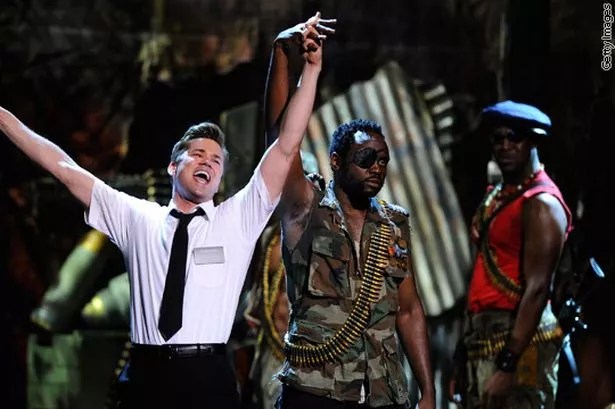
“I believe that in 1978 God changed his mind about black people”
Elder Kevin Price in The Book of Mormon musical on Broadway.
It sounds ridiculous saying it like that, but unfortunately, most members of the church believe that the priesthood and temple ban was God’s will. They believe prophets, past and present, are infallible; and as the mouthpiece of God, they speak on his behalf.
“The Lord will never permit me or any other man who stands as President of this Church to lead you astray.”
President Wilford Woodruff
Do I believe God told church leaders during this time period to ban Black people from fully participating in the church? To intentionally set up institutional racism? To actively discriminate based on the color of someone’s skin?
No.
I do not believe God plays favorites.
“God is no respecter of persons”
Acts 10:34
You may push back and say, “yeah, but sometimes God really does play favorites, like when only the Levites were allowed to use the Priesthood in the Old Testament”.
The Levites’ situation in the Old Testament, however, is fundamentally different than the ban on Black people. The Levites were a minority group with special responsibilities, and non-Levites were not excluded from ordinances and blessings. Special responsibilities for a minority group based on genealogy is much different than blatant discrimination toward a minority group based on outward appearance.
“For the Lord seeth not as man seeth; for man looketh on the outward appearance, but the Lord looketh on the heart.”
1 Samuel 16:7
You might be thinking, “okay, but what about when Jesus came to the Jews first instead of the Samaritans and Gentiles. Maybe each group of people has its own timing before God wants to minister to them.”
Are you sure it’s God’s timing Jesus was waiting for? Don’t forget Jesus was still a part of a prejudiced society. Jews and gentiles did not get along. Yes, the Jews were the starting point. But God has been rooting for everyone all along, not playing favorites.
“He inviteth them all to come unto him and partake of his goodness; and he denieth none that come unto him, black and white, bond and free, male and female; and he remembereth the heathen; and all are alike unto God, both Jew and Gentile.”
2 Nephi 26:33
During his mortal ministry, Jesus Christ never denied anyone, never favored one group of people above another. He went out of his way to minister to those on the margins of society –lepers, sinners, Samaritans, etc. God doesn’t play favorites, but we often do.
I believe God works through imperfect people. People who are doing the best they can. People who have subconscious biases. People who are slightly racist. People like you and me. We all have biases.

Do I believe church leaders, including the prophet, are exempt from human bias? No. Church leaders past and present (Nephi from the Book of Mormon, the apostle Paul from the New Testament, Brigham Young, President Nelson, etc) have biases and are not perfect. Biases from church leaders sometimes manifest themselves in the form of hurtful policies, perceived doctrines taught in the church, or beliefs in a “curse”. These misconceptions eventually get corrected.
Maybe by now you’re thinking, “Now, hold on, are you speaking evil of the Lord’s anointed?”
No, I don’t think so. I am just pointing out that we are all imperfect, including our church leaders. I love our church leaders and I want them to continue to guide and direct us in positive ways.
It’s important to remember that we believe in an ongoing restoration. God is not finished revealing truths or correcting our own misconceptions.
“Sometimes we think of the Restoration of the gospel as something that is complete, already behind us—Joseph Smith translated the Book of Mormon, he received priesthood keys, the Church was organized. In reality, the Restoration is an ongoing process; we are living in it right now.”
Dieter F. Uchtdorf, April 2014
Even though this systemically racist ban on Black people has been removed, there is still plenty of subconscious racism lingering in the minds of church members. The church itself has disavowed theories built on racism, we should do the same –especially around the perceived “God-sanctioned” ban on Black people to attend the temple or hold the Priesthood.
“The Creator of us all calls on each of us to abandon attitudes of prejudice against any group of God’s children. Any of us who has prejudice toward another race needs to repent”
President Russell M. Nelson, June 2020
#2 Systemic Sexism
Suggesting that the church is systemically sexist probably does not sit well with the average member of the church. What does “systemic sexism” even mean? And why would I put such a polarizing label on Christ’s church?
Systemic sexism is discrimination embedded in societal structures, institutions, and cultural norms that perpetuates gender inequality.
In most of the US today, women are not systemically prohibited from doing anything a man can do. A woman can vote, run for president, start a company, serve in the military, etc. Yet, in our church, women are prevented from doing many things that only men are allowed to do –especially around leadership callings.
Some may argue that this is not sexism but rather different yet complementary roles given to men and women based on inherent and divinely inspired differences between the genders. In other words, men and women are “separate but equal”.
Is this what God wants? Maybe all women really are inherently different and should only be allowed to do things appropriate for their gender. Or maybe not. Maybe we have confused our overly-male-focused culture for God’s will. Maybe women really should be equal to men in all things. Let’s investigate further.
A Brief History
In the early church, Joseph Smith used vocabulary such as “ordain” and “keys” when he initially set up the Relief Society under Emma Smith.
“President Smith read the Revelation to Emma Smith, from the book of Doctrine and Covenants; and stated that she was ordain’d at the time, the Revelation was given… elected to preside.
…Elder Taylor was then appointed to ordain the Counsellors— he laid his hands on the head of Mrs Cleveland and ordain’d her to be a Counsellor to the Elect Lady, even Mrs. Emma Smith”
Joseph Smith Papers
Some members will argue that the term “ordain” was used loosely and really just meant “set apart” in modern-day terms, because women are not allowed to be ordained. But I’m not so sure…
“I now turn the key to you in the name of God and
Joseph Smith to the Relief Society, History of the church
this Society shall rejoice and knowledge and intelligence shall flow down from
this time.”
“Turn the key to you” sounds an awful lot like Priesthood keys. And Emma was “to preside” over the Relief Society. It makes sense to me that she would hold the keys for that line of work.
In the 19th and early 20th century, LDS women often anointed and blessed each other and their families. It was a common practice for almost one hundred years.

“Respecting the female laying on hands, it is no sin for any body to do it that has faith. If the sisters should have faith to heal the sick, let all hold their tongues, and let every thing roll on.”
Joseph Smith, 1842
However, the practice of women giving blessings eventually stopped because church leaders began discouraging the practice in the 1920s.
“[the First Presidency] do not encourage calling in the sisters to administer to the sick, as the scriptures tell us to call in the Elders, who hold the priesthood of God and have the power and authority to administer to the sick in the name of Jesus Christ.”
Heber J Grant, 1926, Gospel Topics Essay
Despite the removal of the administration of blessings from women, there was still a feeling of empowerment of women. The church’s women-led Relief Society organization was thriving. They were in charge of welfare programs, had their own Relief Society Magazine, controlled their own funding, and even held their own Relief Society general conferences. As an organization, they truly had autonomy.
In the 70s, however, in the wake of second-wave feminism, the church’s all-male leadership decided to remove some of the Relief Society’s precious autonomy. They made the following changes (source and source):
- Discontinued the Relief Society Magazine (in favor of The Ensign)
- Cancelled its own funding (in favor of a reduced/allotted amount from tithing donations)
- Discontinued its Relief Society general conferences (in favor of a women’s session in general conference)
- Changed the tenure of the Relief Society President from a life-long commitment to a short-term commitment –presidents are now treated the same as other callings in the church and can be released.
- Took control of their welfare program, turning it into a Priesthood responsibility.
- Put themselves, the First Presidency, in charge of presiding over the entire Relief Society.
Today, the message from church leaders is that women are not allowed to hold priesthood keys, give blessings, or preside. The Relief Society started as an independent, strong organization to empower women in this church –and it still does in many ways. However, the Relief Society and women today do not have as much control as they once had.
You could argue that some of these changes were needed due to the growth of the church. Consolidation of resources and reorgs are common among growing organizations. However, is it also possible that some of these changes were fueled by fear around women empowerment? Is it possible the church was influenced by a wider societal culture of devaluing women and the idea of God-promoted male leadership? I think so.
To me, this feels a lot like the culture of some of our Christian cousins who over-emphasize Paul’s sexist writings. Many churches (especially evangelicals) believe the Bible is the word of God and is perfect –including the blatant sexism.
“For it is a shame for women to speak in the church.”
Paul, 1 Corinthians 14:35
Maybe we let some of that chauvinism creep into our church, or maybe it was there since the beginning and just took on different forms (like Polygamy).
Polygamy
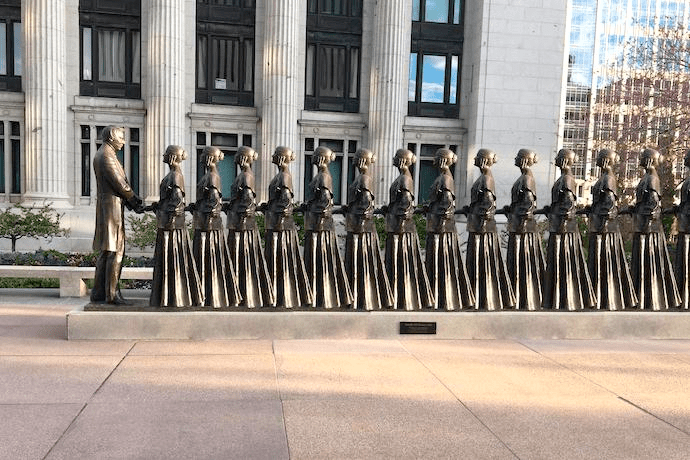
For a long time, the Church Education System ignored or was extremely vague about Joseph Smith’s involvement in polygamy. Around 2013 and 2014, the church officially laid out some of the facts in its Gospel Topics essays (like this one about Polygamy in Nauvoo). They also recently been publishing the Saints book, which has been fairly transparent of the messy facts as well –which many church scholars have worked hard on and their work should be applauded.
FACT: Joseph Smith had 30+ wives.
Some of those wives were teenagers, some were already married to other men, and nearly all were kept secret from Emma.
Here’s some resources to learn more:
- Faithful view: https://josephsmithspolygamy.org/
- Cynical view: https://www.letterformywife.com/the-letter#comp-jxkwol76
Emma Smith had a really hard time when she found out about some of Joseph’s plural wives. But according to Joseph it was endorsed, and in his case, commanded of God to participate.
“If any man espouse a virgin, and desire to espouse another, and the first give her consent, and if he espouse the second, and they are virgins, and have vowed to no other man, then is he justified; he cannot commit adultery for they are given unto him; for he cannot commit adultery with that that belongeth unto him and to no one else.
D&C 132: 61, 62
And if he have ten virgins given unto him by this law, he cannot commit adultery, for they belong to him, and they are given unto him; therefore is he justified.”
According to this scripture, ten virgins can be given to a man, and belong to that man as if they were his own property. As long as there is consent with his first wife, it’s all good. However, Joseph did not consent with Emma about the majority of these additional wives. And in this same D&C 132 revelation Emma is then commanded to stay with Joseph and endure the polygamy –which doesn’t sound like consent to me.
“And let mine handmaid, Emma Smith, receive all those that have been given unto my servant Joseph…
D&C 132: 52, 54
And I command mine handmaid, Emma Smith, to abide and cleave unto my servant Joseph, and to none else. But if she will not abide this commandment she shall be destroyed, saith the Lord; for I am the Lord thy God, and will destroy her if she abide not in my law.”
Many people care about the exact details and motives of someone entering into plural marriage. Like maybe there is an easy-to-swallow reason for it, or maybe some men only did it to fulfill a commandment (ethical) whereas some did it for sexual benefit (unethical). But regardless of the reason, women got the short end of the stick.
Throughout the early history of the church, women were often coerced into participating in polygamous unions through means of spiritual and emotional abuse. Here are a few problematic instances from Joseph Smith’s approach:
- In 1841, Mary Elizabeth Rollins Lightner, already married to Adam Lightner, was coerced into marrying Joseph Smith as a plural wife. Joseph used the argument that an angel had commanded him to take her as a wife (source).
- In 1841, Zina Huntington Jacobs, despite being married to Henry Jacobs, was sealed to Joseph Smith after he claimed an angel with a flaming sword threatened him. After Joseph’s death, she was sealed to Brigham Young while Henry was sent on a mission (source).
- In 1843, Helen Mar Kimball was pressured into marrying Joseph Smith at age 14 after he convinced her that it would guarantee her family’s exaltation (source).
- In 1843, Lucy Walker, age 17, was approached by Joseph Smith to become a plural wife. After refusing multiple times, Joseph threatened that her salvation and that of her entire family depended on her compliance. Eventually, Lucy felt she had no choice but to agree (source).
Do I believe in a God that would give righteous men more wives as a reward or punishment? Do I believe God treats women as men’s property? No and no.
I think Joseph Smith was mistaken. He was so excited about the “restoration of all things” that he even brought back old testament traditions that were created through an unjust male-dominated world in which women were treated as less than men. Polygamy isn’t a beautiful and holy doctrine that makes families and society better. Especially how it was implemented in the church, it was sexist.
You may argue, “yeah, but you can’t judge the past by present-day standards”.
That’s true, so I’ll give those in the past grace. Maybe there were social and economic benefits or something and it really was what the people needed at the time… 🤷. But based on historical accounts of women I’ve read about, it definitely feels wrong to me.
As of 1890 through the Official Declaration 1, The church no longer encourages polygamous marriages. Starting in 1904 with the Second Manifesto and extending to today, anyone entering into a polygamous marriage will be excommunicated immediately by the church. The practice of polygamy during this lifetime is no longer allowed within the church.
However, the belief and practice of polygamy in heaven is ever-present.
FACT: President Nelson is married and sealed to 2 wives.
Men are allowed to be sealed to multiple women in the temple (but women can only be sealed to one man). Of course, to abide by government law, that additional marriage/sealing can only be done after a couple is divorced (by law) or the wife is deceased. But the idea is the same: polygamy in heaven.
If you want to learn more about the negative impact of polygamy, please read The Ghost of Eternal Polygamy by Carol Lynn Pearson, an active church member.
Do I believe in a God that endorses a practice that so obviously disadvantages and devalues women relative to men? Probably not. Maybe if the principle was the same for men and women, but even then it’s still kinda nasty in my opinion.
Gender Roles
In the 1970s, the LDS Church came out against the Equal Rights Amendment (ERA). Their reasoning, among many things, was to persist the idea of gender roles.
“Among the great dangers in the [ERA] is the fact that it would deprive lawmakers and government officials alike of the right by legal means to honor the vital differences in the roles of men and women.“
Boyd K. Packer
In the 1980s, church leaders discouraged women from joining the workforce, finishing a college education, and doing too many things outside of the home when they conflicted with their roles as wife and mother.
“I beg of you, you who could and should be bearing and rearing a family: Wives, come home from the typewriter, the laundry, the nursing, come home from the factory, the cafe. No career approaches in importance that of wife, homemaker, mother–cooking meals, washing dishes, making beds for one’s precious husband and children. Come home, wives, to your husbands. Make home a heaven for them. Come home, wives, to your children, born and unborn. Wrap the motherly cloak about you and, unembarrassed, help in a major role to create the bodies for the immortal souls who anxiously await.”
President Ezra Taft Benson’s 1987 talked titled: To the Mothers in Zion
The church has always reserved separate roles for men and women. Men are to be husbands and fathers. Women are to be wives and mothers. Men are to preside, lead, earn a living, and protect. Women are to create children, nurture, and raise those children.
“By divine design, fathers are to preside over their families in love and righteousness and are responsible to provide the necessities of life and protection for their families. Mothers are primarily responsible for the nurture of their children. In these sacred responsibilities, fathers and mothers are obligated to help one another as equal partners.”
The Family: A Proclamation to the World
Being “equal partners” sounds great, but is it truly equal if the man is “to preside”? I would argue no. Equal partners both preside.
Yes, I know for biological reasons men and women are different. In general, most women are more nurturing than most men. And, in general, most men are more physically strong than most women. However, this is not true for everyone. There are plenty of men who are more nurturing than their female counterpart. And there are plenty of women who are more physically strong than their male counterpart. In my opinion, laws, rules, commandments, etc. should avoid pigeonholing people based on their gender.
While you could argue that male and female is a binary thing –a person is either born female or born male (though some are born with ambiguous genitalia), I would argue that masculinity and femininity is not a binary thing. It’s a spectrum. Being a tender, nurturing father is being feminine. And being a competitive female basketball player is being masculine. We all have masculine and feminine traits, and they are all God-given and beautiful. We should not suppress them in order to fit the stereotypical definition of a man being masculine and a woman being feminine.
Do I believe God wants you to force yourself to fit these stereotypical molds? No. God wants you to be the best version of yourself and embrace all your wonderful masculine and wonderful feminine traits. For many women, this means being a mother and full-time caregiver at home (shoutout to my own rockstar mother). For other women, this means being the founder of a startup company, a professional athlete, or the breadwinner of the family. Your life path is between you and God, not society and gender norms.
Representation
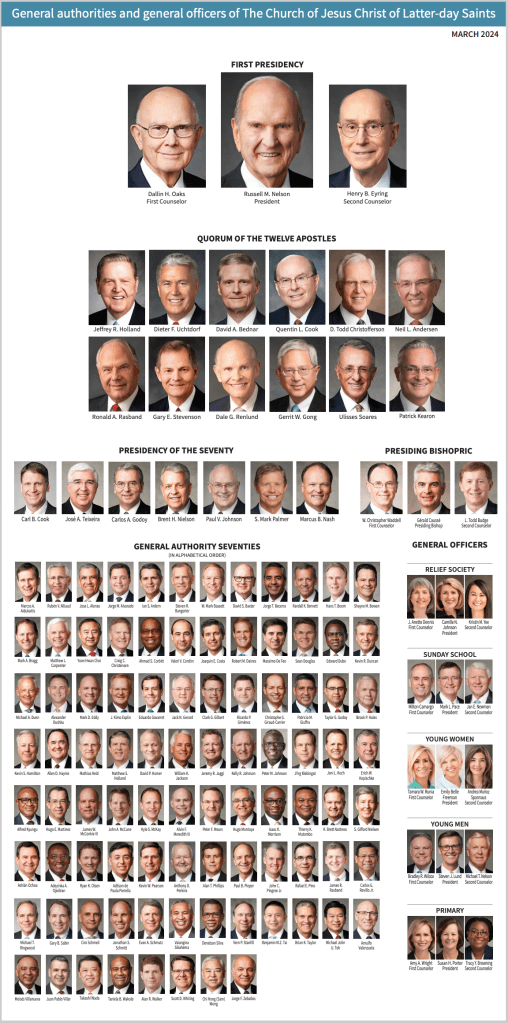
In the church, women are not ordained to a Priesthood office. Yes, technically they act under the Priesthood in their calling and in the temple. And some would argue that women already hold the Priesthood if they are endowed in the temple. But that Priesthood power is only available when a man authorizes it.
Only men hold Priesthood keys.
This fact is the reason women cannot be bishops, patriarchs, stake presidents, mission presidents, area seventy, apostles, prophets, etc. Women are simply not allowed to be leaders over any group in the church that contains men (other than the edge case of primary when there are male teachers in the group). Thus, the sexism here is systemic by definition.
For a more comprehensive list of what women can’t do in the church, please listen to this At Last She Said It podcast episode by two faithful members of the church. It may also be insightful to read this gender-swapped thought experiment/narrative (putting yourself in the shoes of an average woman at church).
In recent years, there have been encouraging words from leaders about the importance and value of women in the church.
“As a righteous, endowed Latter-day Saint woman, you speak and teach with power and authority from God. Whether by exhortation or conversation, we need your voice teaching the doctrine of Christ. We need your input in family, ward, and stake councils. Your participation is essential and never ornamental!”
President Nelson, 2019
However, actions often speak louder than words.
10 men speak at general conference for every 1 woman. 98% of the quotations shared at general conference by apostles and the first presidency are by men (source).
“I’d like the Mormons who insist that male supremacy isn’t a problem in our church to take a good look at the stand. It is filled with men. How many women speak at conference, though they make up over half the population of the church? We know who is valued by behavior, not words.”
Sonia Johnson, 1981
Women do not have equal representation in our church –especially at the leadership level.
One option to remedy this would be to just give women the same level of Priesthood power and authority as men and allow them to serve in any calling including that of a general authority. But, even without a change in the Priesthood, there are many simple policy changes that would push the needle of inclusion forward for women if implemented. Neylan McBaine wrote a book called Women at Church: Magnifying LDS Woman’s Local Impact which explores the idea of policy changes in detail. Some examples include:
- Allowing female leaders to sit in the stands.
- Allowing women to hold their babies in blessing circles.
- Requiring that women be part of disciplinary councils involving other women.
- Adding more artwork of women in our church buildings.
- Instating a female Sunday school president or a male Primary president.
- Allowing a female to be the ward Temple and Family History Leader.
- Using more quotes from female leaders in church lessons.
Some may push back and say, “yeah, but compared to other churches, the LDS church is much more empowering and inclusive of women”. For example, in March 2024 during a worldwide devotional, Sister J. Annette Dennis, First Counselor in the Relief Society General Presidency, made the following controversial statement:
“There is no other religious organization in the world, that I know of, that has so broadly given power and authority to women… My dear sisters, you belong to a Church which offers all its women priesthood power and authority from God!.”
Sister J. Annette Dennis, Worldwide Relief Society Devotional on March 17, 2024
In some ways this is true. Unlike other churches, we do recognize a female deity, a “fortunate fall” which lifts Eve from condemnation, and the endowment of women in the temple –these are wonderful things! But we can do more.
Sister Dennis’ remarks were met with a firestorm of comments on the Instagram post shared by the church. Thousands of women voiced their disagreement. Here are a few of the comments:
“Is this a joke? Episcopalians have women priests. Lutherans have women pastors. Judaism has women rabbis.”
Cynthia Winward
“Yes, priesthood power is given to women in the LDS Church through setting apart for callings and through the Endowment, but it’s ONLY granted through men, by men. Men decide the callings. Men must sign your temple recommend. Men perform the endowment (w/ the exception of the washing & anointing)…
It’s heartbreaking that our Heavenly Mother, our eternal prototype, was not mentioned once in women’s conference. Until we recognize equality of Heavenly Parents, we will not have equality in the organization of the Church or in families. Say her name.”
Dr. Julie Hanks
“I was raised by this village. And there is so much to love about ‘my people,’ but to make a statement like this about other religions who actually do offer women and all members the same power and position as men, is insensitive and disrespectful.”
Mindy Gledhill
“With all the respect and love in my heart, this post is extremely hurtful. I appreciate the opportunities to serve within the RS organization. But as sisters in the LDS church, we absolutely do not have much power nor authority. And very little equality, voice and visibility. The RS organization is overseen by men. Decisions made by women are always approved by or overruled by men. Women are not invited into the meetings where final decisions are made on ward, stake, and church-wide levels. I hope and pray for change. President Nelson reminded us that “Good information leads to good inspiration.” There have been wonderful improvements over the years, and each change has happened after years of prayers and pleading from its members. We are given the gift of discernment and personal revelation. God wants us to follow the spirit and be a force for good. 🙏🏼❤️”
Aria Bethards
Do I believe God doesn’t want women to be leaders over men? Do I believe the church, as it is currently structured, is God’s will and should not be changed to be more egalitarian? No. I believe our Heavenly Parents want us to benefit from the experiences, perspectives, and leadership of women just as much as we do from men.
The Divine Feminine: Heavenly Mother

Our church has a beautiful theology that includes both a Heavenly Father and a Heavenly Mother. This idea is empowering to women because it’s an eternal prototype of who they can become.
“The Church of Jesus Christ of Latter-day Saints teaches that all human beings, male and female, are beloved spirit children of heavenly parents, a Heavenly Father and a Heavenly Mother.”
Gospel Topics Essay
Recently, the church has made a handful of changes to remind us of this cherished doctrine. For example, in 2019 the Young Women theme changed from acknowledging only Heavenly Father to acknowledging both Heavenly Father and Heavenly Mother:
“We are daughters of our Heavenly Father, who loves us, and we love Him.”
The new Young Women Theme
vs.
“I am a beloved daughter of heavenly parents, with a divine nature and eternal destiny.”
Throughout the years, church leaders have included the divine feminine in many talks and lessons. Though little is known about Heavenly Mother, there is so much power in acknowledging her existence and divinity.
“We honor woman when we acknowledge Godhood in her eternal Prototype.”
Elder Rudger Clawson, 1910
However, the attitude of many older church members and leaders is that Heavenly Mother should not be talked about. There are several reasons for this. Here are the most popular:
- Heavenly Mother is too sacred/holy and would be defiled by our own language. If we talked about her, we might defile her in some way and Heavenly Father is very protective of her and doesn’t want us to do that.
- The actuality of a divine feminine is not based on scriptural doctrine –so probably not true.
- There’s polygamy in heaven so Heavenly Mother is more like Heavenly Mothers (plural), which means your Heavenly Mother might not be the same as my Heavenly Mother. And talking about our different mothers would just get confusing.
“Very little has been revealed about Mother in Heaven… Seeking greater understanding is an important part of our spiritual development, but please be cautious. Reason cannot replace revelation. Speculation will not lead to greater spiritual knowledge, but it can lead us to deception or divert our focus from what has been revealed.”
Dale G Runlund, 2022
Okay, it’s fine if we’re not supposed to speculate about Heavenly Mother. But that should not deter us from acknowledging her existence whenever appropriate. We have had this doctrine for a long time and plenty has been said about it. And according to scholars, we’ve never been told to not talk about her.
“We have found no public record of a General Authority advising us to be silent about our Heavenly Mother; indeed, as we have amply demonstrated, many General Authorities have openly taught about her.”
BYU Research Paper, 2011
In other words, if you’re going to mention “Heavenly Father” then, in my opinion, you should also mention “Heavenly Mother”. Or just say “Heavenly Parents” instead. We should stop filtering our Heavenly Mother out of our lives.
Do I believe God wants us to shy away from talking about Heavenly Mother? No. Do I believe in an eternal prototype for women, a divine feminine just as powerful and holy as a divine masculine? Yes, absolutely.
#3 LGBTQ Discrimination
Caveat: My own research and experience with LGBTQ topics is limited. If you want to read a better-researched (and better-written) essay on this topic please see Bryce Cook’s 2017 article here. I should also point out that my research for this section was mostly limited to homosexuality and does not center much around the trans community and their experiences.
Historical Beliefs
Throughout the history of our church, leaders have taught that homosexuality is a curable disease.
“[Homosexuality] is curable and forgivable… Certainly it can be overcome… To those who say that this practice… is incurable, I respond: ‘How can you say the door cannot be opened until your knuckles are bloody…? It can be done’… Some have convinced themselves that they have no desire toward the opposite sex… Let this individual repent of his perversion, force himself to return to normal pursuits and interests… with the opposite sex, and this normal pattern [heterosexual dating] can become natural again.”
Spencer W Kimball in his book The Miracle of Forgiveness published in 1969
Church leaders taught that homosexuality is not something someone is born with.
“It is inconceivable that—as some involved in homosexual behavior claim—[the Lord] would permit his children to be born with desires and inclinations which would require behavior contrary to his plan.”
Homosexuality pamphlet published in 1981 by the First Presidency and Quorum of the Twelve
They also taught that homosexuality is contagious and can spread. Thus, members should not associate with anyone who is gay.
“We [do not] intend to admit to this campus any homosexuals… If any of you have this tendency… may I suggest you leave the University immediately… We do not want others on this campus to be contaminated by your presence.”
BYU President Wilkinson, 1965
In the 60s and 70s the church encouraged efforts to change individual’s sexual orientation. Methods to alter a person’s sexuality included things like arousal reconditioning, electroshock aversion therapy, and even heterosexual marriage (source).
It’s important to note that for the vast majority of cases these conversion therapy programs did not work. The practice is considered unethical by today’s standards and described by experts as torture; cruel, inhuman, and contrary to human rights (source).

In 1995, the church published The Family Proclamation which defined heterosexual marriage as “ordained of God” and gender as “an essential characteristic”.
“Marriage between a man and a woman is ordained of God and that the family is central to the Creator’s plan for the eternal destiny of His children.
All human beings—male and female—are created in the image of God. Each is a beloved spirit son or daughter of heavenly parents, and, as such, each has a divine nature and destiny. Gender is an essential characteristic of individual premortal, mortal, and eternal identity and purpose.”
The Family Proclamation
Recent Changes
The church’s policies and vocabulary around this topic have changed a lot in recent years.
Unethical conversion therapy ideas are no longer encouraged –including heterosexual marriage as a means to set someone “straight”.
“Marriage should not be viewed as a therapeutic step to solve problems such as homosexual inclinations or practices.”
President Gordon B. Hinkley, 1987
Over the years, church members and leaders have worked with gay latter-day saints with love and compassion.
“My experience with the 50 or so homosexuals with whom I have had a
Robert Rees, a singles ward bishop in Los Angeles, CA from 1986 to 1992
close relationship over the past 20 years can be summarized as follows: I
have not met a single homosexual Latter-day Saint who chose or was able to
change or alter his or her sexual orientation. I also have not met a single homosexual Latter-day Saint who had not tried valiantly, generally over a long
period of time, to change his or her orientation.”
Instead of condemning a person for their reality of being attracted to the same gender, church leaders are sympathetic and suggest that it is okay for a gay person to be that way (have homosexual feelings), as long as they do not act on their feelings.
“Same-gender attraction is not a sin, but acting on those feelings is.”
Elder Holland, 2007
In 2004, when asked if gay people were “born that way”, President Gordon B Hinkley replied: “I don’t know. I’m not an expert on these things. I don’t pretend to be an expert on these things” (source).
Church leaders imply that it is possible/probable that some people are just born gay. In the “nature vs nurture” argument, they seem to be taking a different view (maybe it’s both).
“The experience of same-sex attraction is a complex reality for many people. The attraction itself is not a sin, but acting on it is. Even though individuals do not choose to have such attractions, they do choose how to respond to them…
Topics Library
One can, in fact, be gay and live faithful to the teachings of Jesus Christ. “
Despite the positive shift in attitude and vocabulary around LGBTQ people, church policy around same sex marriage has not shifted. The church does not recognize it as a legitimate form of marriage.
“Church officers will not employ their ecclesiastical authority to perform marriages between two people of the same sex, and the Church does not permit its meetinghouses or other properties to be used for ceremonies, receptions, or other activities associated with same-sex marriages.”
Topics Library
Prop 8
In 2008, the state of California had a proposition on the ballot. The Proposition was a voter referendum that would amend the state constitution to recognize marriage as being only between one man and one woman, thus banning same-sex marriage. Same-sex marriage was legal in California due to a California Supreme Court case a few months prior.
Although the church does not often involve itself in politics, LDS church leaders were among the biggest proponents of the proposition and anxiously encouraged its members in California to “vote yes on Prop 8”.
“We ask that you do all you can to support the proposed constitutional amendment by donating of your means and time… Our best efforts are required”
Letter from the First Presidency to members, 29 June 2008
Church members listened to their leaders and took action. Many making financial donations, doing door-to-door canvassing, or even making phone calls to registered voters.
The result was a 52% vote in-favor of the proposition (source).
After Prop 8 passed, there were many protests and accusations against the church for swaying the vote by meddling too much in state politics.
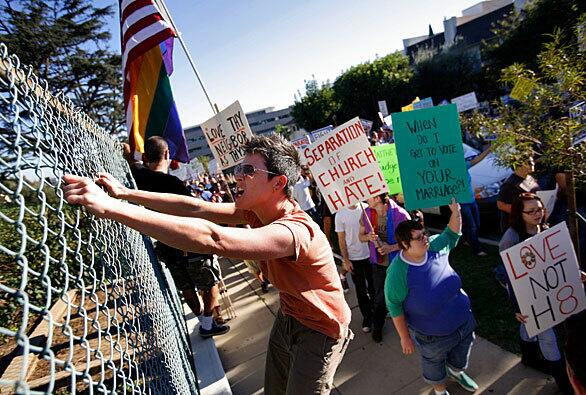
But was the California vote really swayed by the church? After all, church members made up less than 2% of the California population (source).
The answer is yes. According to ProtectMarriage.com, the main proponent of Prop 8, about half the donations they received ($20 million) came from Mormon sources including out-of-state Mormon sources (like Utah), and LDS church members made up somewhere between 80% and 90% of the volunteers for early door-to-door canvassing (source).
The passing of Prop 8 prohibited gay marriages from 2008 to 2013 when a decision was made by the courts to allow the practice again (source).
“Regardless of the court decision, the Church remains irrevocably committed to strengthening traditional marriage between a man and a woman, which for thousands of years has proven to be the best environment for nurturing children.”
Michael Otterson, Church spokesman
Do I believe that defining marriage legally between two people of any gender will harm society? Do I believe allowing gay people to get married is an attack on my own heterosexual marriage? No. Embracing those who are different than ourselves is something Jesus would do.
November 2015 Policy
Same-sex marriage became legal nationwide in the United States on June 26, 2015 (source).
In November 2015, the church added a policy to its handbook stating that anyone involved in a same-sex union is an apostate and requires a disciplinary counsel. Additionally, any children belonging to a same-sex couple (biological or adopted) would be barred from baptism, ordination, or any kind of mission service unless obtaining parental consent, disavowing the practice of same-sex cohabitation and marriage, and getting permission from the First Presidency (source).
“We recognize that same-sex marriages are now legal in the United States and some other countries and that people have the right, if they choose, to enter into those, and we understand that. But that is not a right that exists in the Church.”
Elder D. Todd Christofferson, November 6, 2015
Not surprisingly, this policy was viewed as highly controversial and discriminatory. Criticism of the new policy was wide-spread even among active members of the church. Many were hurt by these policies and the perceived permission it gave members of the church to bully and harass same-sex couples and their children.
In April 2019, the church completely reversed the November 2015 policy.
“These policy changes come after an extended period of counseling with our brethren in the Quorum the Twelve Apostles after fervent, united prayer to understand the will of the Lord”
President Russell M Nelson, April 2019
There was no apology. Church news editors suggest that both the November 15 policy and its reversal in April 2019 were inspired by revelation (God’s will).
“Some changes to policy inspired by revelation are only for a short time. For example, in April 1982, Church leaders announced the length of missions for young men would be 18 months. The First Presidency announced in a November 1984 letter that young men would again serve two years.”
Sarah Jane Weaver, Church News editor
Is it possible that the November 15 policy was not inspired by God? But rather a mistake made by church leaders? Yes, I think so.
You may push back and say, “okay, but if that’s true and it really was a just mistake then wouldn’t church leaders apologize and admit their own mistake?”
Not necessarily. Remember, the church is a non-profit religious organization recognized by the US government as such. The church and its top leaders have to consider any legal repercussions that would come from a formal apology. In other words, they could get sued if they apologized.
Do I believe God wanted this type of policy in-place for exactly three and a half years, no more, no less? No. I think it was a mistake made by church leaders. Leaders are imperfect and make mistakes sometimes.
Negative Consequences
According to a 2022 national survey conducted by The Trevor Project, 50% of LGBTQ youth in Utah seriously considered suicide in the past year and 17% actually attempted suicide. Only 41% of Utah LGBTQ youth identified home as an LGBTQ-affirming space (source) –meaning nearly 60% of these kids don’t feel safe in their own homes.
Could these alarming statistics possibly be linked to the church’s blatant LGBTQ discrimination? Let’s take a closer look at Utah.
In 2018, Utah had the 6th highest suicide rate in the nation. And in the last two decades alone, youth suicide rates in Utah tripled (source).
A visual representation of this data hints at a pattern. Below is a graph taken from Utah’s Public Health Data Resource. The vertical dotted red lines are not part of the original but rather my own insertion to possibly give more context and meaning to the sharp rises in suicide rates after Prop 8 passed and the Nov 2015 policy was enacted.
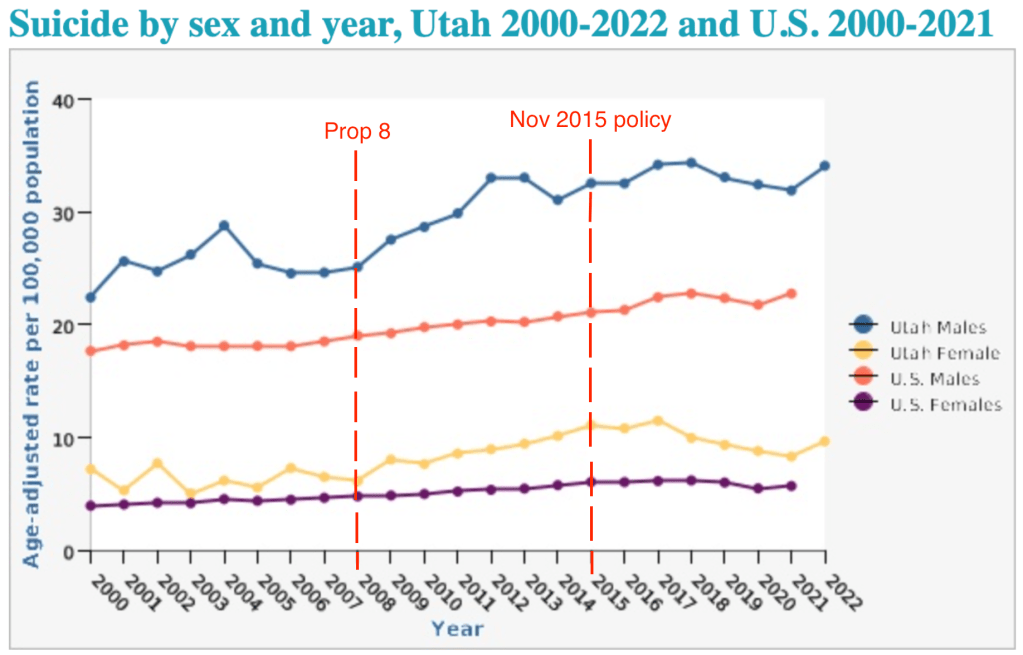
Seems to me that there is a significant rise in Utah suicide rates (for both females and males) each time the church has publicly condemned homosexuality in a big way.
Some argue that it’s not the church’s fault, that causation and correlation are often conflated. It’s true, statistics are difficult to interpret. But regardless, something is definitely wrong. My gut tells me the church may be contributing to this horrific suicide trend in Utah.
It’s impossible to determine the total negative impact of church discrimination against LGBTQ people from statistics alone. However, there is plenty of anecdotal evidence from thousands of people who have been hurt or are currently hurting.
A few years ago, I went to lunch with my former mission president (this was about 6 years after my mission had ended). At the time, I was feeling confused about many former missionaries I had served with who recently came out as gay, and some even leaving the church completely. I asked him what he thinks about their coming out, and I’ll never forget his answer. I’m paraphrasing, but he said something like, “ya know, sometimes people exaggerate certain parts of themselves. At the end of the day, they are choosing to define themselves as gay.” I love my mission president, but I think he was wrong about this.
Is it best to trust our heterosexual church leaders about LGBTQ experiences? Or should we trust the LGBTQ individuals themselves? I believe it is best to learn from the individuals themselves.
Here are a few firsthand stories that have helped me understand the struggles of our LGBTQ brothers and sisters, hopefully they can give you added perspective as well:
- Tom Christofferson’s book published by Deseret Book titled “That We May Be One” (Tom is the brother of Elder D. Todd Christofferson)
- A podcast episode from Charlie Bird and Ben Schilaty (active members of the church)
- Josh Weed coming out as a gay man married to a woman, and then Josh Weed apologizing to the LGBTQ community and announcing his divorce
- Laurie Lee Hall, a transgender woman who designed more than 40 LDS temples and is a former bishop and stake president
- LDS Homosexuality Documentary Part 1, Part 2, Part 3
Is it ethical to encourage gay people to bury, hide, and shame their own authentic sexuality? To think they are born fundamentally flawed, inherently evil, or an “attack on the family”? No, I don’t think so.
Why Does God Allow These Injustices to Happen?
Leaders and members of our church are among the most wonderful people on the Earth. They lead by example, sacrifice so much, and put Jesus Christ at the center of their lives. I am grateful to have grown up in the church. So much of who I am today is because of the church and its relentless focus on Jesus Christ and his teachings.
However, we must recognize that the church is not exempt from social issues around racism, sexism, and LGBTQ discrimination. All of these things are happening in our beautiful church. But why? Why would God allow these injustices to happen in his church?
My short answer/opinion: God is not a micro-manager.
He lets imperfect people lead His church. People with cultural baggage that may predispose them to certain biases. Imperfect people like you and me. He expects us to learn and grow together through the messiness of our own unfairness, prejudice, and hurtful behaviors.
Church leaders, including prophets and apostles, have their agency, and although it may be unintentional, sometimes they don’t steer the church in the right direction.
You might say, “yeah but didn’t God say he would never let the prophet lead the church astray?”
“The Lord will never permit me or any other man who stands as President of this Church to lead you astray. It is not in the programme. It is not in the mind of God. If I were to attempt that, the Lord would remove me out of my place, and so He will any other man who attempts to lead the children of men astray…”
President Wilford Woodruff, Official Declaration 1
“We will not and … cannot lead [you] astray.”
Elder M. Russell Ballard, 2014
Based on the evidence laid out in this blog post, I am inclined to believe that this is simply not true (I’m not the only faithful member who believes this, a blog post by Kimber Albrechtsen covers this topic more in-depth).
You can argue semantics like Anthony Sweat does here (the prophet “makes mistakes”, but that isn’t the same thing as “leading astray”), but to me, mistakes made by leaders of a worldwide church that cause real harm toward large groups of people is definitely “leading astray”.
Church leaders have encouraged members to seek their own personal revelation instead of blindly following.
“What a pity it would be if we were lead by one man to utter destruction! Are you afraid of this? I am more afraid that this people have so much confidence in their leaders that they will not inquire for themselves of God whether they are lead by him.
I am fearful they settle down in a state of blind self-security, trusting their eternal destiny in the hands of their leaders with a reckless confidence that in itself would thwart the purpose of God in their salvation…
Let every man and woman know, by the whispering of the Spirit of God to themselves whether their leaders are walking in the path the lord dictates or not.”
President Brigham Young, 1862
But LDS church culture is often fueled by members unquestioningly submitting to authority.
“When the prophet speaks… the debate is over.”
President Elaine Cannon, 1978
It seems we often forget that our own doctrine tells us the Prophet, his counselors, and the Twelve are fallible people. Elder Uchtdorf (second counselor of the first presidency at the time) reminds us of this fact in his October 2013 talk titled, “Come, Join with Us”.
“To be perfectly frank, there have been times when members or leaders in the Church have simply made mistakes. There may have been things said or done that were not in harmony with our values, principles, or doctrine.
I suppose the Church would be perfect only if it were run by perfect beings. God is perfect, and His doctrine is pure. But He works through us—His imperfect children—and imperfect people make mistakes.”
President Dieter F. Uchtdorf, October 2013
Perhaps a popular comparison between Catholic and LDS beliefs sums this up best:
“Catholic doctrine is that the pope is infallible, but Catholics don’t believe it; Mormon doctrine is that the prophet is fallible, but Mormons don’t believe it.”
Unknown, quoted and explained by FAIR here
In my opinion, it is not fair to church leaders to put them on a pedestal and idolize them. And it’s not healthy for members to blindly accept everything they say with no regard to the negative consequences caused by some of their words and policies.
Yes, we are supposed to sustain our church leaders –and I do sustain them. However, “sustain” to me does not mean I have to agree with everything they say and do. It means I wrestle with what they say, consider the implications, ponder and pray about it. I respect my leaders, allow them to make mistakes, but also push back when they teach something that doesn’t ring true to me. To sustain is to support and help grow.
Conclusion
Jesus Christ, his teaching, and his doctrine is perfect, but our understanding of these things is not. The leaders and members of the Church of Jesus Christ of Latter-Day Saints are not perfect.
Let’s do our part in recognizing the injustices that still exist among us and do as President Nelson suggests and abandon them.
“Today, I call upon our members everywhere to lead out in abandoning attitudes and actions of prejudice. I plead with you to promote respect for all of God’s children.”
President Russell M. Nelson, October 2020
I hope we can do as the prophet suggests and abandon our prejudices, especially against Black people, women, and our LGBTQ brothers and sisters. Love is the answer.
“A new commandment I give unto you, That ye love one another; as I have loved you, that ye also love one another. By this shall all men know that ye are my disciples, if ye have love one to another.”
John 13:34-35
I pray that we can all be more in-tune with the spirit to know right from wrong for ourselves, and to discern when a leader is being inspired or just speaking their opinion. God does not want us to outsource our spirituality to any person, including the prophet. We must take ownership of our own spirituality and learn to recognize the spirit for ourselves.
Yes, we should listen to our leaders and seriously consider all that they teach. But at the end of the day, it is God, Jesus Christ, and the spirit that we must follow because they will truly never lead us astray.
I know the church is not perfect and I am okay with that. But we should not be complacent. We need to push past our comfort zones, recognize any wrong we’ve done, and do better. I know God will be with us as we do so with love ❤️.
“The best criticism of the bad is the practice of the better.”
Father Richard Rohr
 Kev's Blog