
The Scenario
If you are a software engineer, then the following scenario inevitably happens to you:
- Your friend (or relative, neighbor, acquaintance, etc) learns you are a software engineer.
- She tells you about her big idea: a SAAS business that does X, Y, and Z.
- You talk for a while about the potential of this startup idea. You’re both excited –this could result in lots of $$$!
- Your friend wants you to be the technical co-founder (or CTO, tech lead, employee #1, etc).
- You realize this is a big commitment requiring lots of your finite time. You question if this is actually a good idea or not.
- Your friend needs an answer from you: are you going to join her on this startup adventure? Or decline the offer?
What to Consider Before You Commit
“A startup is a human institution designed to create a new product or service under conditions of extreme uncertainty.”
The Lean Startup by Eric Ries
The fact is: 9 out of 10 startups fail. It’s important to evaluate all the risks before jumping in with two feet.
This blog post is my attempt at consolidating and summarizing how I judge an opportunity like the one above. It’s not an exhaustive list, just some of the things I consider to be the most important.
Note: I’ll assume you, as the software engineer, want to primarily focus on building the product.
Here’s what we’ll talk about:
- Validation Work
- Does it pass “The Mom Test”?
- What does the MVP look like?
- What’s the Go-To-Market Strategy?
- Evaluating your friend
- Is she fulfilling her roles and responsibilities as the non-technical co-founder?
- Is she humble enough to focus on learning?
- Are there any red flags?
- What does your gut tell you?
Validation Work
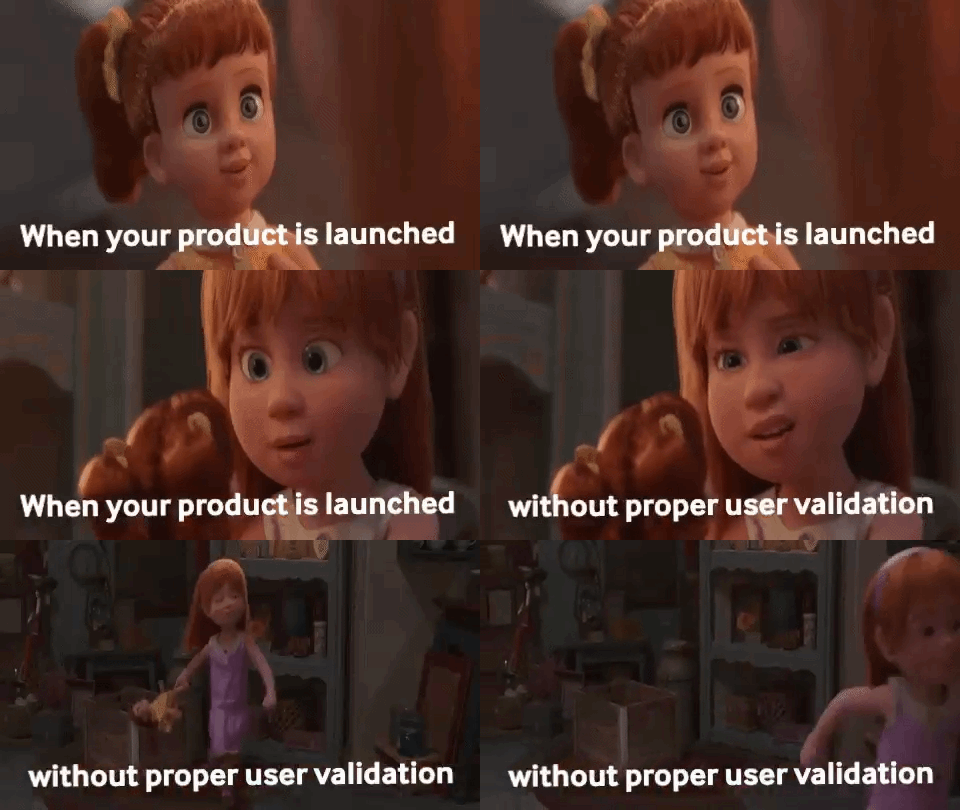
Based on an idea alone, no one can truly determine if the business will succeed or not –there’s too many factors involved. However, with some validation work, we can avoid many of the common pitfalls that plague early-stage startups.
Here are three crucial questions your friend needs to answer about the product/service she wants to build:
- Is it valuable? In other words: would a user pay for it?
- Is it usable? In other words: can the user figure out how to use it?
- Is it feasible/viable? In other words: can we build it?
I’ve read some great books on this topic and have seen first-hand what happens when a founder doesn’t do enough validation work (spoiler alert: the company fails).
Does it pass “The Mom Test”?
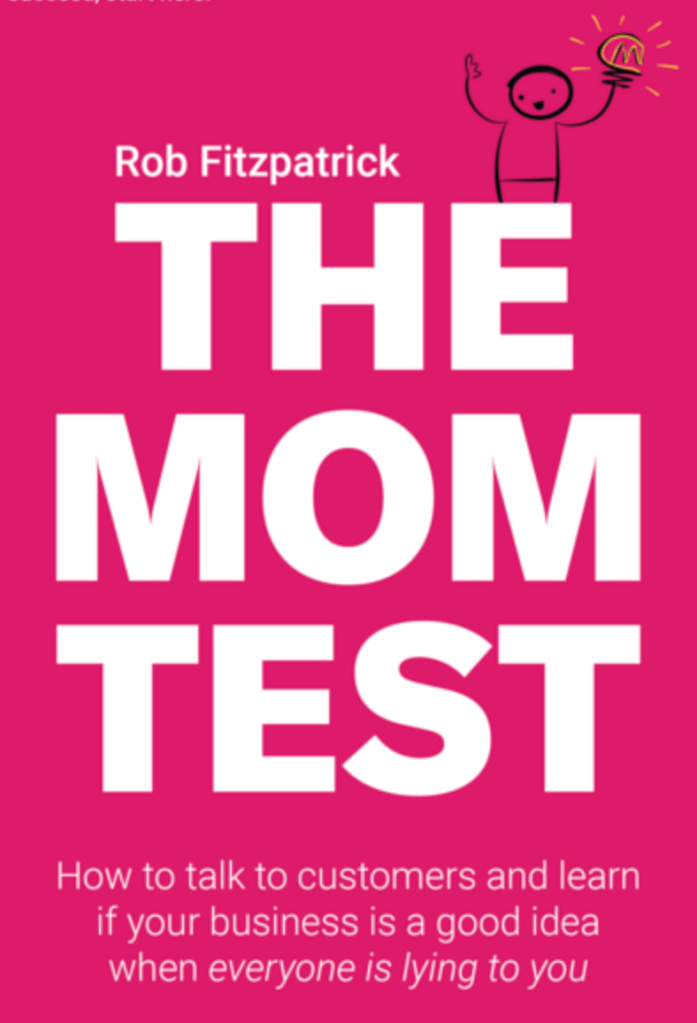
The Mom Test: How to talk to customers & learn if your business is a good idea when everyone is lying to you. It’s a book by Rob Fitzpatrick.
The main idea is that people often want to be supportive and avoid hurting your feelings –people like your mom, your friends, or even complete strangers. They give you positive feedback even if they don’t genuinely see value in your idea. False positives == lies!
“Collecting a fistful of false positives is like convincing a drunk he’s sober”
The Mom Test by Rob Fitzpatrick
The book will train you to get honest answers from potential users about the solution you’re trying to sell them. One strategy for this is to get a commitment from the people you interview. For example, instead of asking “do you think this is a good idea?” You ask them “Will you buy this product for $50?” And if you’re still building the product you can always collect a check now and promise not to cash it until the product is built and delivered to them.
“Rule of thumb: People stop lying when you ask them for money.”
The Mom Test by Rob Fitzpatrick
What does the MVP look like?
It’s easy to get excited about the grand vision of a fully-featured product, but it’s all got to start somewhere. Figuring out a good minimum viable product is critical.
MVPs should be built with immediate user value in mind. For example, to solve a problem such as transportation needs, your MVP should not be building the wheels of your dream car. Wheels are not valuable by themselves. Instead, build a skateboard and then iterate from there.
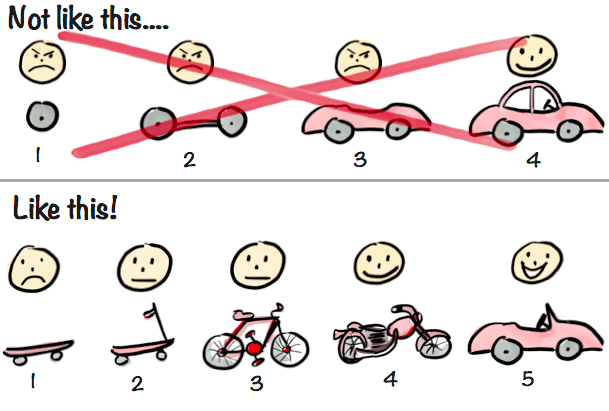
Chasing the elusive “product-market fit” is no easy task. You are going to be wrong about a lot of things. The trick, then, becomes a question of how quickly you can learn. Build, measure, learn, repeat. That’s what you have to do.
“The lesson of the MVP is that any additional work beyond what was required to start learning is waste, no matter how important it might have seemed at the time.”
The Lean Startup by Eric Ries
What’s the Go-To-Market Strategy?
A naive startup believes that “if you build it they will come” –but this is simply not true. Launching and finding your first paying customers is often a struggle.
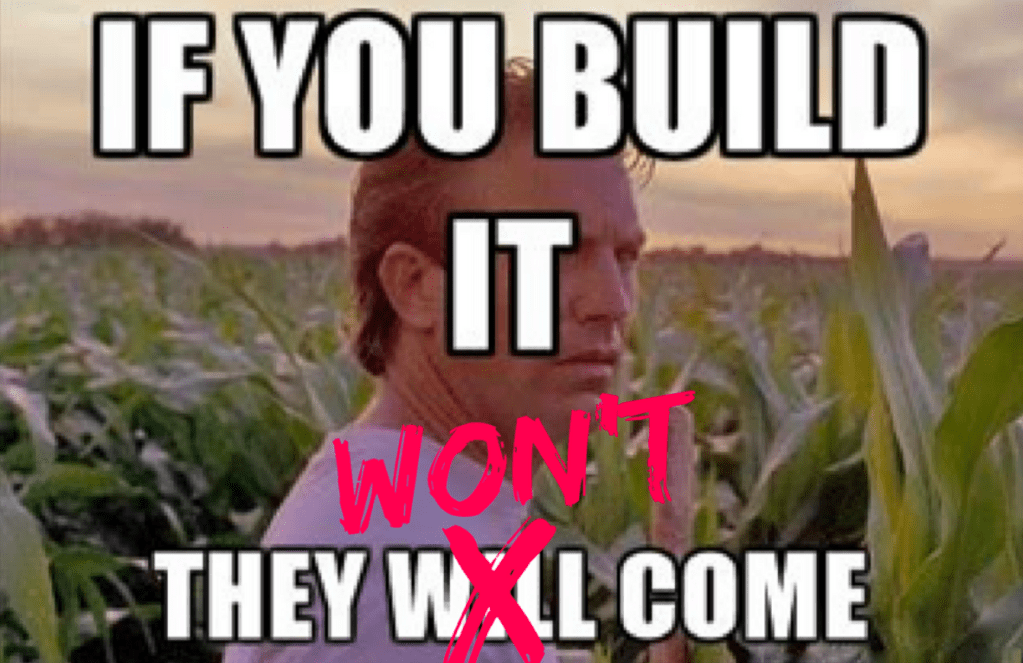
The go-to-market strategy is something that you will need to figure out ahead of time. Just like the product idea, it needs to be validated. You need to experiment and iterate. Remove opinion, and focus on what the data tells you.
For example:
Tim Ferriss, when writing his famous book, spent $200 on a Google Adwords campaign in order to validate the best title for his book. He tested six different ads with headlines as potential book titles –the one with the most clicks would be the winner. The resulting data came in and “The 4-Hour Workweek” was born.
“The best results in life are often held back by false constructs and untested assumptions”
The 4-Hour Workweek by Tim Ferriss
Assumptions won’t work. The messaging and marketing around what you’re building needs to be tested. And there are lots of channels to test with. You’ll need to experiment with stuff like:
- Pay-per-click google ads
- Facebook ads
- SEO
- Industry events & trade shows
- In-person visits
- Referrals
- Influencers
- etc
Without an effective sales funnel based on data from your testing, your software will collect dust.
Evaluating Your Friend

A startup company will resemble its founder in many ways: its marketing/messaging, the decisions made, the company culture, etc. It’s important then to evaluate your friend to figure out if she has what it takes and if you would want to work at a company controlled by her.
Is she fulfilling her roles and responsibilities as the non-technical co-founder?
Founders wear a lot of hats, especially in the early days of the startup. Key responsibilities include:
- Vision
- Product management (including validation work, talking to customers, MVP design, product roadmap, etc)
- Business Setup and Finance Management
- Sales and Marketing
- Fundraising
- Hiring
- Networking
- Legal and Compliance
- Customer Relations

The technical co-founder will likely spend the majority of their time focusing on building the product, which means most (if not all) of the above responsibilities will fall on the non-technical co-founder. However, it’s often a good idea to share some of these responsibilities –especially the product management one.
“Product manager, you are responsible for defining the right product, and your engineering counterpart is responsible for building the product right.”
INSPIRED by Marty Cagan
At the end of the day, the important thing is that someone is owning each of these areas of responsibility. If your friend can’t fulfill all of them, then take note of the gaps and consider that in your overall evaluation.
Is she humble enough to focus on learning?
“The unit of progress for Lean Startups is validated learning –a rigorous method for demonstrating progress when one is embedded in the soil of extreme uncertainty.”
The Lean Startup by Eric Ries
“Validated learning” is a concept that emphasizes the importance of testing assumptions and hypotheses through real-world experiments. It’s that data-driven process we’ve been talking about: Build, measure, learn, repeat.
This learning process requires humility. If your friend is in-love with her own solution, she may trust too heavily on her own un-proven ideas and opinions –building on false assumptions, which is dangerous.
A humble founder is dedicated to fixing the problem, not forcing their solution to work –which may mean pivoting a few times before you find a solution that works for your users.
“Fall in love with the problem, not with the solution.”
INSPIRED by Marty Cagan
Are there any red flags?
- Is she arrogant?
- Does she lack the determination and grit to persist when things get tough?
- Is she more interested in becoming rich than solving a real problem?
- Is she married to her solution as-is?
- Has she never successfully done something like this before?
- Past success does not guarantee future success, but it does help.
- Did she have you sign a NDA (non-disclosure agreement) before telling you her idea?
- This usually just means she’s a noob and overly-protective of her ideas, which are cheap. Execution is what really matters.
- Has she never read any of the books I’ve been mentioning in this blog post?
- Okay, maybe I’m biased because I love these books, but they really are helpful books all entrepreneurs should read.
What does your gut tell you?
The gut check can tell you a lot. Don’t dismiss your raw feelings about your friend.
- Do you like working with this friend of yours?
- Does your working relationship come naturally?
- Do you trust them? Do you have rapport?
- Is the opportunity still worth it even if it ultimately fails?
Conclusion
As a software engineer, your skills and expertise bring immense value to any startup endeavor. But the decision to take that leap should be based on a thoughtful evaluation of the idea and your friend.
So, if you believe in your friend’s startup idea, have faith in her processes, enjoy working with her, and won’t resent her if it ultimately fails, then go for it! #FullSend

However, if you are not sold on your friend’s startup idea, then you should either decline their offer or ask for compensation instead. Forget about the bootstrapping, sweat equity, stock options, potential valuation, etc. Just ask for hard $$$ so you don’t carry any of the risk if it fails.
Resources
- The Lean Startup by Eric Ries
- Nail It Then Scale It by Nathan Furr & Paul Ahlstrom
- INSPIRED: How to Create Tech Products Customers Love by Marty Cagan
- The Mom Test: How to talk to customers & learn if your business is a good idea when everyone is lying to you by Rob Fitzpatrick
- The 4-Hour Workweek by Tim Ferriss
 Kev's Blog