
TL;DR
Writing is the primary way we communicate. Write better!
Why did I write this blog post?
Last year I got my first 100% remote job; most of my communication with coworkers is through written text. For example:
- Slack
- Jira
- Confluence
- The source code itself

Now more than ever, I have felt the negative consequences of poorly written communication. And yes, I am to blame for many of these miscommunications. I want to improve, and I want to share what I’ve learned so far.
What are the consequences of bad writing?
- Wasted time
- Wrong decisions because of misinterpretation
- Hurt feelings that dampen teamwork
“If your words can be perceived in different ways, they’ll be understood in the way which does the most harm.”
The above quote is from Basecamp’s blog post (#8 in the list).
Side note: I once heard the founders of Basecamp in a podcast explain that their top hiring requirement for applicants is good written communication skills. Apparently, part of the interview process is a simple instant-messaging chat conversation to see if you can communicate your ideas effectively via text – pretty radical way to make sure they only hire top-notch communicators!
How can we improve?
1) Choose the appropriate channel of communication
“If it’s important, critical, or fundamental, write it up, don’t chat it down.”
source: Basecamp’s blog post (#6 in the list)
In other words, if your writing will most likely be referenced in the future don’t write it in Slack or an email. Create a Confluence page or README for more permanent communication.
Also, it’s possible the best channel of communication for your task is not through writing. The old adage “this meeting could have been an email” can sometimes go the other way, especially in 100% remote situations. Brief phone calls or screenshares can save messaging time and misunderstandings.
2) Don’t make me think!

I once read a UI/UX design book with this title and it’s main message has stuck with me. The book is basically saying: “don’t design stuff that is difficult for a user to understand how to use thus causing them to think“.
You can apply this principle to written communication in the same way. Put yourself in the reader’s shoes. How will they interpret what I’ve written? What can I say that will be easiest for them to understand?
Or, as my wise father-in-law once told me:
“Communicate in such a way that the other person cannot misinterpret what you’re saying”
Giving context to your question or comment will help tremendously and prevent a lot of the back-and-forth/miscommunication. Give the reader everything they need to understand your text.
3) Be clear, not fancy
Avoid overusing the TLFs (three-letter-acronyms  ) and the industry/tech jargon. As someone new to the healthcare industry, I appreciate when things are spelled out for me so I don’t have to google it.
Another thing to consider here is your writing’s accessibility. I work with a lot of people where English is not their first language. If I keep my writing simple more people will understand it. This blog post has some good tips: What makes writing more readable?
4) Help others
None of us are perfectly articulate. If you’re reading something that isn’t clear then don’t hesitate to ask for clarification. Engage with other’s writing: reply to a thread in Slack, comment on Confluence docs, update outdated documentation, etc.
Remember, we’re all in this together!  (that is definitely not a High School Musical reference)
5) Improve your chat etiquette
Be friendly, but also get to the point
I’m mostly talking about the way we start a chat conversation. Don’t start it with “Hi George“ and then just wait for a response before continuing to ask a question or tell them something. It’s usually an attempt to be polite and conversational; in reality, it wastes time.
You can still say “hi“, just get to the point in that same breath.
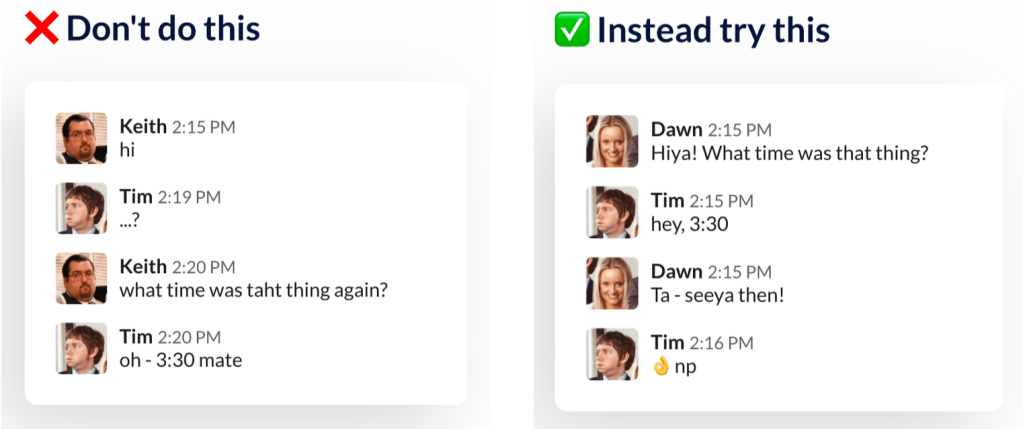
source: no hello
Don’t leave them hanging
If you’ve read something, give it a thumbs up or some sort of indicator to tell the writer you read it. Especially if it’s an urgent request, it is polite to reply with a “gimme a sec“, or “in a meeting, please hold“ message that tells them you’ve seen their message and will get to it later.

Deep work time (quiet hours) is also needed – a defined time during which it’s perfectly acceptable not to respond. Each team is different, so it’s important to get with your team and set expectations around this.
Proofread your messages
Especially if the message includes more than 1 other person (like a Slack channel with 20+ people in it). Before you hit the send button, re-read what you wrote and most likely you’ll fix a typo or re-word something that wasn’t clear AND you’ll save everyone tons of time!
Conclusion
As devs working mostly remote, let’s do our best to communicate clearly and save ourselves some frustrating moments of confusion. Here’s to good written communication  !
!
 Kev's Blog
One thought on “The Importance of Good Written Communication”